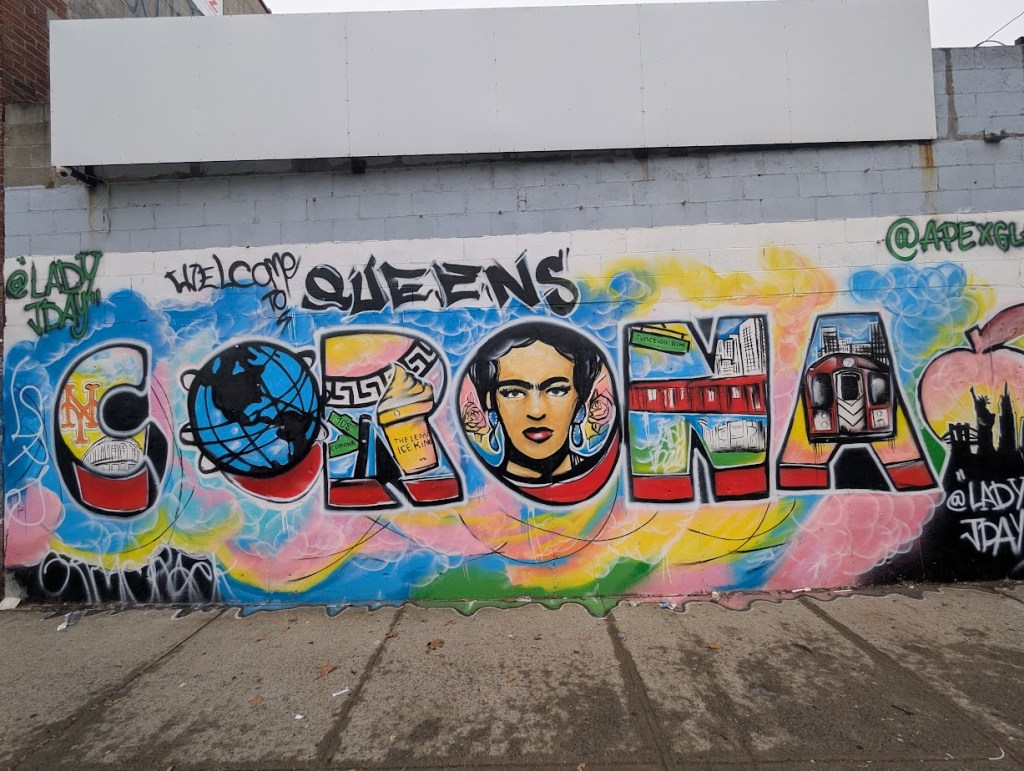
Every New Yorker has seen them around. Graffiti on a wall saying “Welcome to…” the area in question. Or a mosaic proclaiming that THIS neighborhood, of all the neighborhoods in the city, was the actual best. Some artist thought enough of where they lived or grew up to celebrate it in artwork. But have you ever wondered how many of them there were? Have you ever wondered if one existed for every neighborhood in the city?
I did. On my birthday two years ago, I began looking for these murals as a kind of scavenger hunter, with the optimistic goal of finding a mural for every single neighborhood in the city, and taking my own photograph for posterity.
The criteria for what I counted as a “neighborhood mural” was simple:
- It has to be somewhat artistic in nature. A plain printed sign doesn’t count. This can include paintbrush illustrations, mosaics, spray-painted graffiti, digital displays, or printed vinyl banners. Graffiti was by far the most popular, being the medium of choice for over half of the murals.
- It must be a direct reference to the neighborhood itself, not something named after a neighborhood. So A bagel shop with “Williamsburg, Brooklyn” on the wall counts, but a sign that says “Williamsburg Bagel” doesn’t. Nicknames count; “The Heights” for Washington Heights, for example, or “The Southside” for South Jamaica.
- It has to be in the neighborhood it represents, or nearby (more on this later).
- It has to be semi-permanent in nature. No posters or t-shirts.
I found these murals through a mixture of googling for them, trawling Google Maps StreetViews of major streets, recieving tips from friends, and often by randomly stumbling upon them in my daily travels. So after two years, hundreds of miles of traveling by foot, bus, subway and sometimes car, I have a Google Photos album of my findings. It began as a hobby, a side quest of sorts. But for this story I’ve decided to analyze the photos and share my findings.
A few trends stick out:
Murals tend to show up on a few types of buildings
Unsurprisingly, New Yorkers aren’t keen on placing large works on art on the side of their homes: only six were located in or on a residential building. So where do these murals show up? Typically, buildings meant as public gathering spots, or where the the owners don’t care about aesthetics:
- Corner stores
- Public schools
- Industrial areas like warehouses or construction sites
- Expressway underpasses
Three quarters of the the art pieces in this collection are on one of these types of structures.
Artists like to show off their neighborhood’s character
Much of the artwork shows includes imagery and symbolism reflective of the neighborhood, either its history or the people living there. Some of my favorite examples:
- This one, in Ridgewood, is a pun on the name, featuring trees (woods) overlooking a hill (a ridge).
- A mural in Bed-Stuy features colorful block print reminiscent of a Spike Lee movie poster, along with an appearance from rapper Notorious BIG.
- Woodlawn, an historically Irish American neighborhood, features the Irish flag.
This collection isn’t very inclusive
The Weissman Center for International Business (2021) maintains a database that lists over 300 distinct neighborhoods in the city, and most aren’t represented in my collection, despite my best efforts. For this story I’ve created a geotagged map of the murals; you’ll notice the disparities in where they don’t show up:
You’ll notice the large empty areas encompassing central Brooklyn and most of Staten Island. There’s an obvious explanation for this: those areas are almost exclusively residential, and are populated predominately by ethnic whites; urban street art, especially graffiti, has roots in black and hispanic culture (Sotheby’s, n.d.).
So it’s no surprise then that areas like South Bronx and Northwestern Brooklyn, areas which were until recently mostly known as Hispanic and African American enclaves, respectively, have so many murals. Bedford-Stuyvesant, Brooklyn and Mott Haven, Bronx in particular have more than four art pieces each celebrating their communities.
Border disputes abound
I’ve compared my geotagged map with the Baruch maps: many murals are located near, but not technically in, the neighborhood they represent. A mural for New Lots, for example, is located in East New York. A mural for East New York is located in New Lots. Artists are not necessarily cartographers, after all, and disagreements about where a neighborhood begins and ends is a city tradition. The New York Times created an interactive map (Buchanan, 2023) where they relied on crowdsourcing to determine the borders of each neighborhood. Needless to say, the lines ended up blurred.
The work continues
New York City is a massive place. I’ve lived here for 36 years and I still haven’t seen most of it. Some of this artwork I’ve discovered purely by random chance. The murals for Sunset Park and Ridgewood, for example, are painted on the roll down gates of storefronts; had I not happened to be walking by when these stores were closed, I’d have never spotted them. So my work to find more of these isn’t over by any means. Each mural I find, and every photograph I take, adds a little bit to my understanding of the city I love.
Works Cited
Buchanan, L. (2023, October 30). An extremely detailed map of New York City neighborhoods. The New York Times. https://www.nytimes.com/interactive/2023/upshot/extremely-detailed-nyc-neighborhood-map.html
Sotheby’s Institute of Art. (n.d.). Graffiti art. https://www.sothebysinstitute.com/info-series/graffiti-art
Weissman Center for International Business. (2021). New York City (NYC) neighborhoods – By borough. Baruch College, City University of New York. https://www.baruch.cuny.edu/nycdata/population-geography/neighborhoods.htm


Leave a comment